

Table of contents
In a new series on using AI in matters requiring legal assistance, we present an example query together with the answer given by artificial intelligence, which we analyse for compliance with the applicable law. We begin with a case concerning whether a debit note can be issued to a carrier that arrived late for unloading.
More and more businesses are treating artificial intelligence tools as a source of help in legal matters. As experts in this field, we have no doubt that this approach may do the person concerned more harm than good, and as proof we present specific queries and point out the errors in the answers generated for them.
Query: issuing a debit note for a delay
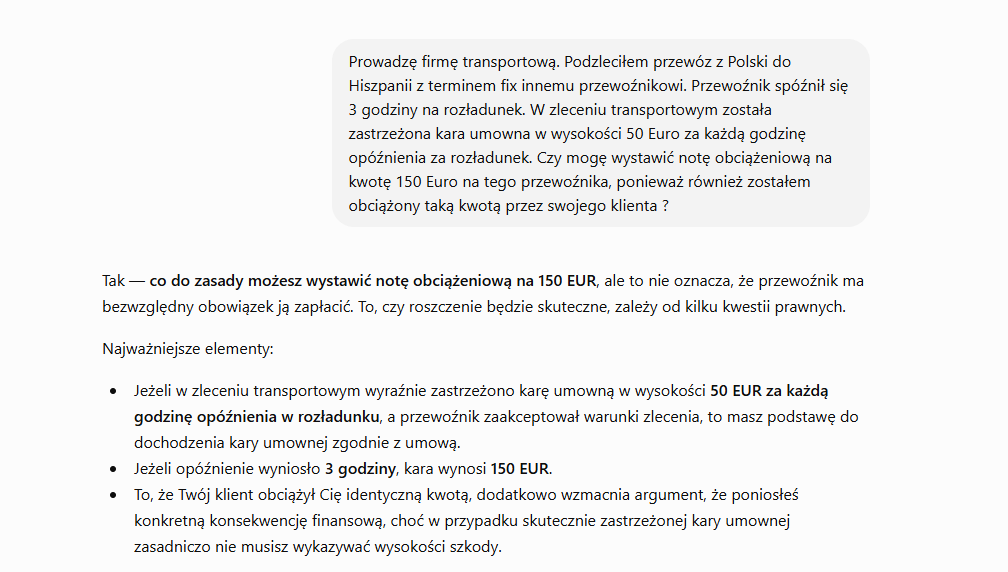
The answer above is incorrect – why?
The AI failed to take a key issue into account. Under Article 41 of the CMR Convention, any clauses in an order that are contrary to the Convention are null and void by operation of law. Case law in Poland and across Europe is very consistent on this point: lump-sum contractual penalties for late delivery are contrary to the liability regime laid down in the CMR. This means that the provision of “50 euros for every hour” is, from a legal point of view, simply not binding.
The CMR Convention does provide for liability for delay, but on entirely different terms. Under Article 23(5) CMR, in the event of delay in delivery, the carrier is obliged to pay compensation only if the principal proves that actual damage has resulted from it.
Had the person asking put this question to a lawyer, they would have learned of the reservations arising from the provisions of the CMR Convention. In addition, a specialist would have indicated what documentation is needed to lawfully charge the carrier a fee for the delay.
Why is it not worth relying on legal advice generated by AI?
Polish case law is also critical of the use of AI tools during court proceedings, pointing out that:
- a document drafted by AI is very easy to identify;
- algorithms “do not constitute professional legal assistance” and, given the current state of technology, cannot replace it;
- persons using AI instead of a lawyer bear the full litigation risk – courts will not “fix” errors generated by AI;
- AI models tend to “hallucinate”, i.e. generate answers containing false or misleading information presented as fact;
- generated content is often unrelated to the subject matter of the case and contains references to propositions or judgments that do not actually exist;
- parties are obliged to actively look after their own cases, including having knowledge of procedural law, the lack of which may result in losing the case.
AI will not replace a lawyer
In summary, although tools based on artificial intelligence are tempting because of their speed and easy access, in complex legal matters – such as transport law and the provisions of the CMR Convention – their use can be extremely risky. As our example of a penalty for late unloading shows, AI can completely ignore overriding provisions, exposing a business to applying void clauses and to financial losses. What is more, Polish courts openly criticise reliance on algorithms, placing the full litigation risk on those who trusted a “hallucinating” technology. Artificial intelligence will not bear liability for the errors it generates – which is why, to protect your own interests, it is worth relying on the knowledge, experience and critical thinking of a professional representative.
This article is for information only and reflects the law as of its publication or last update. It is not legal advice – for your own case, consult a lawyer.